Those who are waiting for the Middle Eastern states to sacrifice trade with China in protest of their treatment of Muslim ethnic minorities, will be waiting forever.
China’s economic and diplomatic relationships with Middle Eastern (ME) states have flourished in tandem with its intensifying national policies of ‘de-Arabisation’. This has caused many western commentators to decry the lack of support from Islamic states around the world for the plight of China’s Muslim ethnic minorities. As well as representing a failure to understand the complex relationships Arab states have with Muslim ethnic minorities in their own countries, these statements fail to recognise that ME states are playing by the rules of a realist international world order we created, where national interest allows players to turn a blind eye to a nation’s worst atrocities, as long as the money is right.
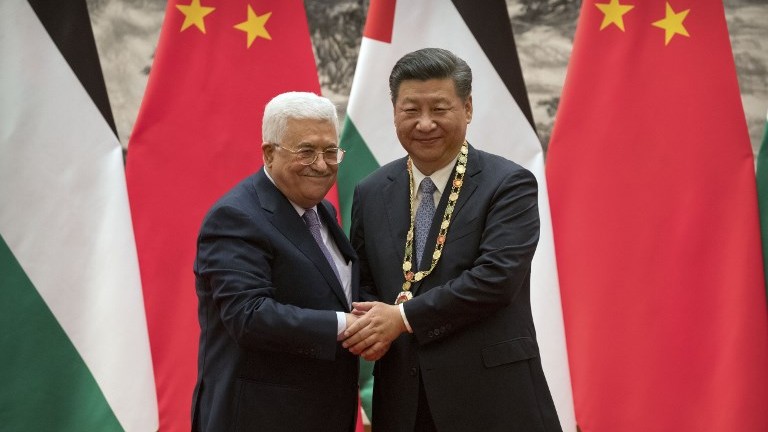
Last week, Palestinian President Mahmoud Abbas wrapped up a four day whistle stop tour of the PRC. He was invited by Qin Gang, the Chinese defence minister, who for the second time offered to mediate peace talks between Palestine and Israel. Qin Gang follows a long line of Chinese political figures openly calling out the total, growing and oppressive control Israel operates on all areas of Palestinian life. This legacy dates back to the Bandung Conference, where China took a leading role in the nonaligned nations search for a ‘third way’ between the big powers of the Soviet Union and the U.S, of which the Middle Eastern and North African (MENA) states made up a significant portion. As well as close historic diplomatic ties, Chinese trade with the Middle East has exploded in the 2010s. In 2016 China surpassed the US to become the largest investor in the region, and as of 2022 its total trade with the ME is worth $330 billion, equivalent to the GDP of Ireland.
Yet a week before Abbas’ visit, a 13th century mosque in the Hui Muslim region of Yunnan had three of its minarets and a dome roof razed by local authorities, causing protests and locals clashing with police. This is the latest Mosque to fall victim to a sustained national policy of ‘de-Arabisation’. China has always had a complex and often violent relationship with its ethnic minorities, who mostly live on the countries frontiers with Central/Southeast Asia. But in 2018 a leaked confidential directive entitled “Reinforcing and Improving Islam Work in the New Situation”, laid bare the acceleration of China’s hardline approach to ‘sinicising religion’. Use of the Islamic financial system was prohibited, Islamic ‘entities’ were banned from organising nurseries or after-school programs, halal restaurants had to remove Arabic language and Islamic imagery, and Arabic language schools could not teach religion. In Xinjiang these policies are meted out under the guise of a war on Islamic extremism, and a 2021 Human Rights Watch report into their enforcement, which includes the illegal detainment of Uyghurs in “re-education” camps, accused China of crimes against humanity.
This has led to sustained anger and confusion amongst western political commentators, at Arab states deepening engagement with a country that persecutes Muslim’s so extensively. Bradley Jardine of the Kissinger Institute, claimed in a recent time article that ‘The Arab World isn’t Just Silent on China’s Crackdown on Uighurs, Its Complicit,’ while Nick Cohen decried ‘nations that claim to be defenders of the faith offer no protest to the concentration camps.’ Although it is right to call out any government’s lack of action in the face of such abhorrent injustice, comments like these reveal the lack of understanding we have of China’s, and our own, historic relationship with the Middle East, as well as Middle Eastern states relationships with each other.
Muslim Arab states are not a homogenous entity. The terrible legacy of the Balfour declaration, and the straight lines that boxed historically warring ethnicities into the same polities, has led to a 20th century Middle East marked by dominant ethnic groups suppressing other Muslim minorities, such as the Kurdish in Syria and Turkey, and Azeri in Iran. The history of cold war foreign interference, and more recently the 2011 ‘Arab spring’, has deepened the paranoia amongst leaders in the ME of dissidents and revolt. Guy Burton, Visiting Fellow at the LSE’s Middle East Centre, argues that for these reasons, many ME states are likely to “sympathise” with the Chinese suppression of their own Muslim ethnic minority, even without the financial incentive.
But really Kissinger and Cohen’s main gripe, is that MENA states are using China’s ‘war on terrorism and extremism’ as an excuse to ignore its atrocities, so that they can keep benefitting from an eye watering volume of Chinese trade and investment. It is hard to believe however, that this dynamic does not feel familiar to either author, considering that the global north has been benefitting from the very same system, as long as the U.S. has run the worlds security and trade relationships. There are plentiful examples of the wests involvement in similar agreements, but perhaps the one most likely to jog the memory of British authors like Nick Cohen, is the UK selling £7.9 billion pounds worth of bombs to Saudi Arabia for them to drop on Yemen, in a conflict which has killed 377,000 people since 2015.
Furthermore, while not having a democratic mandate definitely leads the CCP to be far less tolerant than democratic nations of pluralism within its borders, most of the language of China’s ‘war on terror’ and the cooperation of Middle Eastern states in the illegal extradition, disappearance and imprisonment of innocent people on trumped up charges of extremism is straight out of the U.S. playbook. Kissinger and Cohen’s comments are another example of us holding other states foreign policy to a higher standard than our own, only allowing realist ‘interest’ based power politics to be a fair excuse for ignoring atrocities when we do it.
My point here however, is not to add to the discourse slurry pit, filled with analysts trumpeting China or the U.S. over one an other as a more selfless international actor, but to instead trumpet Lord Acton’s famous caution: big powers are always bad powers. China has been in the big power club for decades now, and it is exemplifying the hypocritical foreign policies befitting of a superpower desperate for the energy resources found bountifully in the cradle of civilisation, asking for silence on “internal issues” as part of the deal. And ME states are all too happy to play by the realist rules, as even without the establishment of this unfortunate international relations precedent, the brutal legacy of colonialism in the Middle East, makes them especially unlikely to offer any kind of support for China’s Muslim ethnic minorities in the near future.
 Britain and China