From the golden era to the dark ages: where does the British China relationship go from here?

The British Government’s stance on China is riddled with contradictions and a historical lack of understanding.

A recently published report from the Intelligence and Security Committee (ISC) characterises the threat from China as less James Bond and more Jeff Bezos. It is the overt, by-the-book economic ties that underpin our relationship with the worlds second largest economy, that are now seen as the primary threat.

The report however, fails to offer any real suggestions as to how we can successfully ‘de-risk’ this economic relationship without ‘de-coupling’ completely. It also inadvertently exhibits the lack of expertise among the British Government on China’s politics and international ambitions. This seemingly leaves the UK with few viable options to counteract such a large and ambiguous Chinese threat, besides hiding behind the U.S. and hoping for the best.

The ISC report does offer sound criticism of the short-termism that has coloured British engagement with China in recent years. It brings to light valid concerns about the organizational security of British intelligence services and the ever-growing leverage that China is increasingly wielding over countries outside of its immediate geographical sphere of influence.

However, the document’s description of China’s specific malicious intentions towards the UK lacks precision, blurring the line between de-risking and de-coupling. In doing so it seemingly mirrors the G7’s indecisive stance following their March meeting in Hiroshima, where they were unable to commit to unilateral decisions on China because of the huge economic reliance of certain western European nations on Chinese trade.

The same ambivalence permeates this report, and is best incapsulated in its list of China’s malicious intentions vis-à-vis the UK, which describe China’s aims: ‘to encourage the UK to endorse China as a reliable partner (and thereby boost its reputation on the global stage); and 2: to ensure China can benefit economically from the UK (in particular by seeking UK endorsement of Chinese national champions and through the purchase of UK technology companies).”

This frames the Chinese threat within the typical economic and diplomatic relationship dynamics between a major and middle power, and fails to distinctly delineate the unique challenges China poses to the UK. It shows us that our fear of China is not really about national specific security concerns, or human rights. Our fear really, is that China is now big enough to pose a threat to U.S. hegemony and therefore any sector, industry, or business where it dominates, is deemed as a threat to the west.

However, the report falls short in providing concrete solutions to address the threats it outlines. This is partly down to its predictably crude description of Chinese domestic politics and their international ambitions. It begins with the most basic summary of China’s authoritarian political system, and throughout leans heavily on academic experts to explain the most fundamental tenants of Chinese history and politics.

This lack of understanding exposes an age-old blind spot within UK decision-making circles. Relying on China experts from British universities underscores the stark contrast with the comprehensive expertise dedicated to understanding other global powers. This deficiency leaves the UK ill-equipped to pre-empt, engage with, and make the most of Chinese international strategies and economic decisions.

The slightly panicked tone is arguably the most important aspect of this report. If anything it should serve as a clarion call for the UK Government to prioritise China rather than creating more distance. This doesn’t have to mean we become closer diplomatically, but ignorance is what got us here, and information should be the solution. We need to dedicate more resource to help foster a better understanding of China in government, but also among the general public. To avoid a future China strategy that merely clings to the coat-tails of the United States, it’s imperative the UK transcends ambivalence and fear. A holistic focus on Chinese history, politics and culture will help us better predict and pre-empt their interest in the UK. It is the pathway to genuinely mitigating the risks within our relationship with a nation rapidly re-shaping the world.
The struggle to understand Middle Eastern support for China

Those who are waiting for the Middle Eastern states to sacrifice trade with China in protest of their treatment of Muslim ethnic minorities, will be waiting forever.

China’s economic and diplomatic relationships with Middle Eastern (ME) states have flourished in tandem with its intensifying national policies of ‘de-Arabisation’. This has caused many western commentators to decry the lack of support from Islamic states around the world for the plight of China’s Muslim ethnic minorities. As well as representing a failure to understand the complex relationships Arab states have with Muslim ethnic minorities in their own countries, these statements fail to recognise that ME states are playing by the rules of a realist international world order we created, where national interest allows players to turn a blind eye to a nation’s worst atrocities, as long as the money is right.

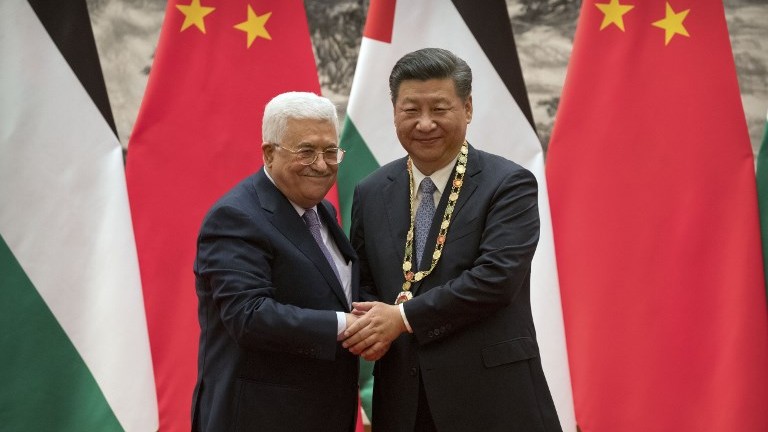
Last week, Palestinian President Mahmoud Abbas wrapped up a four day whistle stop tour of the PRC. He was invited by Qin Gang, the Chinese defence minister, who for the second time offered to mediate peace talks between Palestine and Israel. Qin Gang follows a long line of Chinese political figures openly calling out the total, growing and oppressive control Israel operates on all areas of Palestinian life. This legacy dates back to the Bandung Conference, where China took a leading role in the nonaligned nations search for a ‘third way’ between the big powers of the Soviet Union and the U.S, of which the Middle Eastern and North African (MENA) states made up a significant portion. As well as close historic diplomatic ties, Chinese trade with the Middle East has exploded in the 2010s. In 2016 China surpassed the US to become the largest investor in the region, and as of 2022 its total trade with the ME is worth $330 billion, equivalent to the GDP of Ireland.

Yet a week before Abbas’ visit, a 13th century mosque in the Hui Muslim region of Yunnan had three of its minarets and a dome roof razed by local authorities, causing protests and locals clashing with police. This is the latest Mosque to fall victim to a sustained national policy of ‘de-Arabisation’. China has always had a complex and often violent relationship with its ethnic minorities, who mostly live on the countries frontiers with Central/Southeast Asia. But in 2018 a leaked confidential directive entitled “Reinforcing and Improving Islam Work in the New Situation”, laid bare the acceleration of China’s hardline approach to ‘sinicising religion’. Use of the Islamic financial system was prohibited, Islamic ‘entities’ were banned from organising nurseries or after-school programs, halal restaurants had to remove Arabic language and Islamic imagery, and Arabic language schools could not teach religion. In Xinjiang these policies are meted out under the guise of a war on Islamic extremism, and a 2021 Human Rights Watch report into their enforcement, which includes the illegal detainment of Uyghurs in “re-education” camps, accused China of crimes against humanity.

This has led to sustained anger and confusion amongst western political commentators, at Arab states deepening engagement with a country that persecutes Muslim’s so extensively. Bradley Jardine of the Kissinger Institute, claimed in a recent time article that ‘The Arab World isn’t Just Silent on China’s Crackdown on Uighurs, Its Complicit,’ while Nick Cohen decried ‘nations that claim to be defenders of the faith offer no protest to the concentration camps.’ Although it is right to call out any government’s lack of action in the face of such abhorrent injustice, comments like these reveal the lack of understanding we have of China’s, and our own, historic relationship with the Middle East, as well as Middle Eastern states relationships with each other.

Muslim Arab states are not a homogenous entity. The terrible legacy of the Balfour declaration, and the straight lines that boxed historically warring ethnicities into the same polities, has led to a 20th century Middle East marked by dominant ethnic groups suppressing other Muslim minorities, such as the Kurdish in Syria and Turkey, and Azeri in Iran. The history of cold war foreign interference, and more recently the 2011 ‘Arab spring’, has deepened the paranoia amongst leaders in the ME of dissidents and revolt. Guy Burton, Visiting Fellow at the LSE’s Middle East Centre, argues that for these reasons, many ME states are likely to “sympathise” with the Chinese suppression of their own Muslim ethnic minority, even without the financial incentive.

But really Kissinger and Cohen’s main gripe, is that MENA states are using China’s ‘war on terrorism and extremism’ as an excuse to ignore its atrocities, so that they can keep benefitting from an eye watering volume of Chinese trade and investment. It is hard to believe however, that this dynamic does not feel familiar to either author, considering that the global north has been benefitting from the very same system, as long as the U.S. has run the worlds security and trade relationships. There are plentiful examples of the wests involvement in similar agreements, but perhaps the one most likely to jog the memory of British authors like Nick Cohen, is the UK selling £7.9 billion pounds worth of bombs to Saudi Arabia for them to drop on Yemen, in a conflict which has killed 377,000 people since 2015.

Furthermore, while not having a democratic mandate definitely leads the CCP to be far less tolerant than democratic nations of pluralism within its borders, most of the language of China’s ‘war on terror’ and the cooperation of Middle Eastern states in the illegal extradition, disappearance and imprisonment of innocent people on trumped up charges of extremism is straight out of the U.S. playbook. Kissinger and Cohen’s comments are another example of us holding other states foreign policy to a higher standard than our own, only allowing realist ‘interest’ based power politics to be a fair excuse for ignoring atrocities when we do it.

My point here however, is not to add to the discourse slurry pit, filled with analysts trumpeting China or the U.S. over one an other as a more selfless international actor, but to instead trumpet Lord Acton’s famous caution: big powers are always bad powers. China has been in the big power club for decades now, and it is exemplifying the hypocritical foreign policies befitting of a superpower desperate for the energy resources found bountifully in the cradle of civilisation, asking for silence on “internal issues” as part of the deal. And ME states are all too happy to play by the realist rules, as even without the establishment of this unfortunate international relations precedent, the brutal legacy of colonialism in the Middle East, makes them especially unlikely to offer any kind of support for China’s Muslim ethnic minorities in the near future.

The Belt and Rifle Initiative: a sea change in Central Asian security relationships is coming

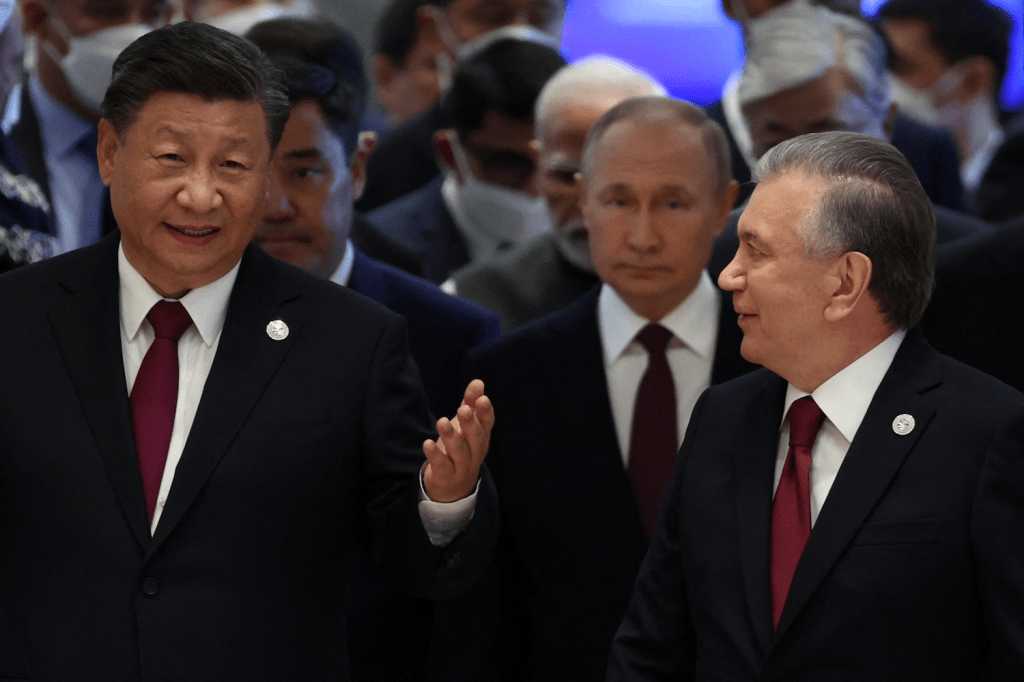
Last week Xi Jinping chaired the inaugural ‘China-Central Asia Summit’. The five autocratic leaders of the ‘C5’ (Kazakstan, Kyrgyzstan, Turkmenistan, Uzbekistan and Tajikistan) travelled to Xi’an, the starting point of the ancient Silk Road, to discuss energy, trade, education, and regional security.

With Russia and the US both drained by costly and unpopular wars in Ukraine and Afghanistan, Xi took the opportunity in his opening address, to pitch China as the regions new security guarantor. Having both your trade and security dominated by one superpower neighbour, is historically never a very popular proposal, but with no one else at the auction, it may well be an offer the C5 cannot afford to refuse.

All the states attending last weeks summit were once firmly in the orbit of the Soviet Union. After its collapse Russia retained the role of security guarantor for the regions strongmen, who required protection against the threat of ‘colour revolutions,’ popular discontent and each other. However, since China’s economic ascendency, the region has enjoyed a ‘multi-vector’ set of political and economic relationships with its superpower neighbours.

Mainly kickstarted by the launch of the Belt and Road Initiative in 2013, the PRC became the area’s dominant investor and trading partner, and during the mid 10’s a balance formed, Russia handling the regions security, China handling business. This has been largely favourable to all parties, allowing the Central Asian nations to avoid creating dependencies on any-one of the big powers, and allowing Russia and China to share the resource burden their roles require of them.

However, last year Russia threw a Ukraine shaped spanner in the works. Today, with the Red Army barely moving, the regions confidence in Russia’s ability to guarantee its security is falling apart. No serious material shifts in trade or bi-lateral agreements have occurred yet, but key players in the C5 are making their anxiety and discontent heard. In outright protest of Russia’s “beligerency” in Ukraine, Kazakh President Kassym-Jomart Tokayev, recently refused to recognise the annexation of Donetsk and Luhansk at the Saint Petersburg International Economic Forum.

With this context weighing heavy on all attendees of last weeks summit, Xi looked to put China in pole position to fill the vacuum a Russian retreat from central Asia might cause. The summit’s official communique heralded the meeting as bringing the China – Central Asian relationship into a “new era”, where security would be a central pillar:

  • “It is important to safeguard peace in the region. China is ready to help Central Asian countries strengthen capacity building on law enforcement, security and defense, support their independent efforts to safeguard regional security and fight terrorism, and work with them to promote cyber-security. The countries will continue to leverage the role of the coordination mechanism among Afghanistan’s neighbours, and jointly promote peace and reconstruction in Afghanistan”

Although there is no specific mention of Russia in the document, committing to “coordinating” efforts to reconstruct Afghanistan, and describing China as standing “ready” to strengthen and support the [Central Asian nations] efforts to “safeguard regional security” make his ambitions to play a greater role in governing the security relationships in the region pretty transparent. Besides, for a man as famously cryptic as Xi, this is about as blunt as it gets.

This is the latest and boldest move Xi has made towards progressing his ‘Global Security Initiative.’ Launched late last year, it is as big as his Belt and Road program in scope, and aims to challenge the western democratic security order of treaties and international organisations led by the US.

For this reason, developments in Xi’an will significantly spike the red scare in Washington. But with building hostility towards Biden’s investment in Ukraine at home, as well as a recent chaotic withdrawal from a deeply unpopular war in Afghanistan, the US simply cannot afford to go toe to toe with China in this part of the world, as it once did with Russia. The money and public support simply isn’t there. Secretary of State Antony Blinken, in a visit to Astana in early March announced $25 million to “diversify trade” in the region. Pocket change, when compared to the $3.7 billion China announced a month later.

History, geopolitics and time, are all pointing towards a central Asia dominated by China. This is not what central Asian states will want, and it is certainly not the future Russia wants. They will resist this for as long as they can, and depending on how the war in Ukraine pans out, the status quo could hold for longer than expected. But the damage to the Russian economy, Putin’s reputation and most importantly his military, has made this a question of when, not if.

G7 on China: All for one and one for all?

In many ways that pertain solely to the war in Ukraine, the G7 leaders are more aligned and steadfast than ever. But on uncertain questions about the future of the international order, and China’s intentions and role within it, their very different priorities keep them as divided as ever.

The 49th G7 summit was held in the Japanese city of Hiroshima, separated from the contested Taiwan strait only by a few hundred miles of East China Sea. There, while promising the largest package of support for Ukraine since the war began, the G7 used China’s close relationship with Russia as the focal point for a series of ‘united’ statements against the threat China’s potential economic and military expansion poses to the worlds U.S. dominated security and trade relationships.

This China focussed section of the summit’s communique is prefaced with the usual ‘de-risking not de-coupling’ preamble: “we stand prepared to build constructive and stable relations with China… our policy approaches are not designed to harm China nor do we seek to thwart China’s economic progress and development.” Yet swiftly the document tacks to calling the PRC out on a number of hot button issues, including atrocities in Xinjiang, their ‘non-market policies and practices’ in world trade, and their aggressive military behaviour in the South China Sea. Finally the 7 leaders call on China, to press Russia to ‘immediately, completely and unconditionally withdraw its troops from Ukraine.’

On the surface, these resolutions seem to confirm what U.S. National Security Council spokesperson John Kirby told reporters before the summit: “You can expect to hear at the end of those discussions that all the G7 leaders are of a common mind about how to deal with the challenges that the PRC presents.” However, the diplomatic lines of the communique only thinly veil deeply held disagreements between G7 leaders on their approach to China.

Two recent visits to Beijing from French President Macron, and German Chancellor Olaf Scholz, reveal the fault lines that exist between those in Europe who want to ‘persuade Xi away from Russia’ and those wedded to the US and Tokyo in their more existential, hardened stance on China’s rise. In the cases of France and Germany in particular, their positions have deep roots that are inseparable from the economic history and geo-political space these nations occupy in the world.

Indeed, it has been less than a month since Macron cause uproar in the international community, by insisting NATO should focus primarily on the ‘Euro-Atlantic theatre,’ and that ‘Taiwan was not Europe’s fight.’ So as much as they say they are moving forward together, the G7’s underlying divisions and conflicting interests continue to threaten American prospects for a truly cohesive approach to China, that stops the PRC further augmenting the international order the U.S. have dominated for so long.

China’s regulatory blitzkrieg in perspective

Flying too close to the CCP

27/03/2022

China’s full frontal assault on its tech giants cannot be written off as another example of autocratic paranoia. International anti-trust action against global techbehemoths is too important.

On April 10th of last year, China’s State Administration for Market Regulation (SAMR) kicked off a regulatory assault on China’s tech companies, by slapping a fine of RMB 18.228 billion on ecommerce giant Alibaba. The dominos then began to fall as Baidu, Tencent, Xiaomi, and most recently JD.com all fell foul of SAMR sanctions. In the popular western consciousness, this crackdown has been seen within the context of a paranoid authoritarian political system, scared of the potential consequences these unregulated tech giants could have on the party’s legitimacy. While maybe part of the picture, we shouldn’t let the current state of the worlds international relations, stop us from acknowledging that anti-trust action like this is something the UK needs desperately.

A year after the storming of the Alibaba offices, as the war in Ukraine rumbles on, an increasing chorus of western businesses, commentators and politicians have been pushing for the economic sanctions levelled at Russia to include China too, for its close ties to Putin’s regime, and refusal to condemn his invasion. The basis of these calls have strong grounds. As covered in last weeks piece (scroll down), Russia and China declared a ‘no limits partnership’ in February this year, and US intelligence reports found Chinese officials to have had prior knowledge of Russia’s plans to invade Ukraine. However, as it did at the height of the trade war in 2018, this tension, along with a sharp dip in Chinese markets this week, has renewed some pretty ‘red scare’ era assessments of China regulating its tech sector.

A lot of these assessments see the regulatory blitzkrieg as caused by the same legitimacy concerns that prompted inaction on Russia’s invasion of Ukraine, the Uyghur genocide, and other CCP atrocities. Peggy Hollinger argues the current regulations are the tip of the iceberg: “The risks of doing business in China have been growing for some time, with the Uyghurs, Hong Kong ect, forcing companies to think about contingency plans. Speaking to Jeremy Goldkorn of SupChina, veteran tech investor Rui Ma, when asked what seemed to have spooked investors, also replied “a better question is what hasn’t spooked investors. The ADRs (Chinese companies listed on the U.S. stock markets), which contains a lot of Chinese internet companies have been declining pretty steadily over the last year. Covid spiking, regulators fining Tencent, Ukraine, all these are good places to start.” Max Zenglein, Chief economist at the Mercator Institute for China Studies is another analyst who sees Chinese regulations as exposing foreign companies to ‘political risk,’ as opposed to purely financial problems: “In the past year… companies have been scrambling to find a solution to maintaining their economic interests in China while realising they are exposing themselves to political risk.”

However, the behaviour of China’s major tech firms before the crackdown, suggest regulatory change is not rooted in authoritarian paranoia. Regulating multinationals, is not an isolated issue reflecting the unresolvable competing interests of autocrats and tech tycoons, but an international issue causing heated debate in the EU and US. Amazon is just one company in the west, whose unfair control over pricing, and access to financial and technological resources, have led to a weak bargaining position for independent sellers, a monopoly in the ecommerce market, as well as an increasing influence in the physical market also. Alibaba, is guilty of all these things, but to an arguably greater degree, due to the speed at which China’s internet economy exploded in the late noughties. The SAMR found Alibaba to have abused its dominance over the ecommerce market by devising a ‘choose one from two’ strategy, aimed at effectively forcing sellers to rely exclusively on its platform. Some traders on Alibaba’s platform were contractually obliged to stay off competing platforms, with others threaten with loosing promotional privileges and visibility rights.

In the niche world of Antitrust law, experts have heaped praise on SAMR’s decision. Largely because it resonates with battles ongoing in the west, against silicon valley tech firms, their abusive labour relations, and their anti-competitive monopolies. The point being here, is we don’t need to praise the CCP to recognise that regulations similar to those sweeping China, are desperately needed here in the UK too. We should try our best to stop the polarised state of global politics leading us to partisan conclusions that don’t make sense. Just as Amazon are not the good guys because they are American, anti-trust laws don’t make China ‘uninvestible’ because they were enacted by the CCP.

How do sanctions on Russia affect China’s unstoppable rise?

Into uncertainty

13/03/2022

Russia’s invasion of Ukraine is clearly a watershed moment for the worlds commercial and security relationships, but as of today it is not clear why.

Recent events in Ukraine have thrown the grand narrative of China’s unstoppable rise into the air, leaving analysts scrambling to see how the lay of the land will change once the dust settles. China is Russia’s closest ally, a fact affirmed by a meeting between Xi and Putin on February 4th, where they declared a ‘no limits partnership.’ As well as the usual diplomatic posturing, this meeting included a commitment to boost bilateral trade to 200 billion dollars by 2024, following an already staggering 35.9% increase in 2021 (to 146.9 billion).

The recent history of this interdependence is rooted in the need for financial, technological and agricultural self reliance, which has been of critical importance to both nations in the hostile international environment of the last five years. After sanctions against Russia in 2014 and the 2018 China-US trade war, both nations have been slowly weaning themselves off a dependence on American currency, technology and food. Speaking to Reuters, Deng Kaiyun, head of Zhejiang’s chamber of commerce, pointed out that “yuan-rouble settlement has become a normal business transaction nowadays… we business people are already accustomed to that.’ Rather than a complete scramble then, the move away from the dollar has been in the works for some time, and the fault lines in the global financial system have been growing more unstable along with it.

Staying with the natural disaster analogy, the invasion of Ukraine is a 9.5 magnitude earthquake. The unprecedented sanctions levelled by a surprisingly united west, have severed the bulk of Russia’s economy from the majority of its world trade. While few predicted a full scale invasion of a sovereign nation would be the catalyst for major ‘de-dollarization,’ the speed of Russia’s ousting from SWIFT and western business more generally mean Putin has little choice but to accelerate the process.

Russian businesses have been left scrambling to open Chinese bank accounts, with analysts arguing Russia could use its Yuan reserves and China’s SWIFT competitor ‘CIPS’ to mitigate the sanctions damage. Some, such as Dang Congyu of Founder Securities have a startling confidence in the long term affects of this shift on China’s economy: ‘The SWIFT sanctions against Russia are a “milestone event that will accelerate the process of de-dollarization… although its hard to replace SWIFT in the short term, this incident is very beneficial to yuan’s globalisation over the long run.”

Yet Dang’s assessment is not widely accepted. China cannot afford to absorb the shock of a collapsing Russian economy by itself, and simply using Yuan will not stop the shot term damage inflicted on the Rouble. The unprecedented nature of these sanctions has left people who five years ago were certain the world was destined to continue a slow march towards Chinese dominance, uncertain whether the dollar will remain king, or this crisis will be the shock therapy the rapidly developing east needs to realign the global economy in its favour.

To answer this question, it’s important to know whether China had any advanced knowledge of the invasion. Is this the next masterstroke in an IR chess game, or a desperately ill informed overreach that reveals just how isolated Xi and Putin are? Some believe China knew more than it has let on, its actions in the build up to the invasion demonstrating calculated support for a form of military action Xi also intends to launch on Taiwan. The timing of the February 4th ‘No limits partnership’ meeting, and the dramatic rise in bilateral trade commitments last year, are both strong indicators that Beijing and Moscow have been preparing to weather the storm they knew would hit them when Russian tanks rolled west. Joe Biden has also cited intelligence reports that claim senior Chinese officials asked their Russian counterparts in early February not to invade Ukraine before the end of the winter Olympics.

However, Russia-China analyst Yun Sun believes there is evidence to suggest the relationship between the two is more distant and pragmatic than their commitments to friendship would have us assume. Practically this is demonstrated by the majority of Chinese analysts and policy figures insisting there would be no war, as well as the non existent attempts to evacuate Chinese citizens in Ukraine prior to the invasion, leading to a mad scramble to do so after. Longterm, China also had very little to gain and quite a bit to loose from a Russian invasion of Ukraine. Even if Putin assured Xi that it would be swift, the sanctions incited by an invasion of a sovereign nation were bound to have ramifications for Russia’s closest ally. Furthermore, the idea that China is involved in a sudden synchronised attempt to speed up the decoupling of the financial system from the dollar, or is using Ukraine to test the waters for an eventual assault on Taiwan, is diametrically opposed to its historic prioritising of long-term stability over everything else.

In my view, rather than revealing weaknesses or strengths in either the U.S. or Chinese position, the Ukraine crisis reveals a dependency our predictive models still have on an Anglo centric ‘rules based order.’ Since the fall of the Berlin wall, an interdependent globalised financial system has been a powerful incentive for states to abide by the rules of U.S. hegemony and has largely shaped our outlook on which direction the world is heading in. It has been a brutal neo-colonial system, and has decimated many developing nations, but for the worlds largest economies it has provided stability and predictability. However, in the wake of Russia’s invasion of Ukraine, sanctions have caused the most dramatic decoupling of a major world power from this global system since the Cold War, and now makes it incredibly difficult to predict the short or long term trajectory of international relations.

A year ago no one thought Russia would invade Ukraine, 3 weeks ago no one though Russia would be booted from SWIFT. We are moving beyond a time in which political disagreements among the worlds most powerful nations could be largely separated from, and mitigated by, trade and commerce. This means we are also moving beyond a time when we could use these metrics to predict the long or short term future of their relationships.

The fourteenth five year plan

Consumption, innovation and industry take centre stage, but striking long term political goals are hiding in plain sight.

On Friday the 5th of March, the first session of the annual National Peoples Congress commenced in Beijing. The meeting of the worlds largest parliamentary body typically lasts between 10-14 days, and is mostly tasked with ratifying major changes in policy, electing government officials, and setting the political tone for the year, whether it be one of continuity or change. However this year is exceptional, as the NPC is tasked with passing the 14th Five Year Plan of the PRC, as well as only the second ever 15 year plan laying out a vision for Chinese life in 2035.

Track record tells us the path of Chinese development is about to change tack. Policy proposals will seek to ramp up, slow down or tighten control over various sectors of society. From the proposal released by the Fifth Plenum of the Central Committee meeting in November, and the first few meetings of the NPC this week, it seems policy is moving firmly away from a relentless focus on GDP percentages. The annual growth figure is still important, at 6.4%, but is both modest in lieu of previous estimates (as well as in the eyes of the IMF), and has not been extended past 2021. This is the first time expected growth rates have been restricted to one year since 1979.

Fundamentally this shows what has been known to many China hawks for a long time; quality of growth is taking precedence over the quantity in the eyes of the Chinese political elite. Innovation has been key to these concerns, with the US trade war exposing China’s reliance on silicon valley software (semi conductors). Domestic consumption has also stagnated at around 40% in recent years, as per capita incomes also plateau. Whilst consumption and technological independence have been on the agenda in Zhongnanhai for over a decade, the current hostile international environment has created a sense of urgency that emanates from the policy proposals released so far.

What does this mean for Britain? Generally commentators are split on what this new direction means for Chinese interaction with the rest of the world. It obviously depends on where you are sitting, but the argument is usually over whether a rush for self sufficiency will see China turning inward economically, or the rush for a consumption fuelled economy will lead to more opportunities for the British service centred economy. However, a relentless focus on economic trends on both sides of the debate has obscured the elephant in the room; rising political tensions between China and the US dominated western world.

This anxiety has been exacerbated by a politicisation of the trade war, challenging the neutral hand of the market. Whilst even the most ardent neoliberal would concede this neutrality has never really existed in its ideal form, it has proved a useful illusion for enforcing international trading standards and regulations, in the face of political instability and bilateral disagreements. These have in turn, helped maintain a degree of peace and cooperation in big power relations since the collapse of the Soviet Union. The 2019 arrest of Huawei’s CFO Meng Wanzhou has seen the illusion shattered, as trade and national security become evermore inseparable in US China policy. A recent Gallup poll lays bare this creeping McCarthyism, with US citizens views of China at an all time low of 30%.

For Britain I thus think optimists and pessimists have got the wrong end of the stick. Viewing the current five year plan through the tunnel vision of a purely economic lens will fail to account for the shifting political sands that are are allowing irrational economic activity to masquerade in the name of national security. It is thus crucial to view the economic opportunities that this new Chinese direction have for the UK, through the prism of the political and historical tensions that underpin it. Self sufficiency in technology and food, coupled with a determined stance on crushing dissent in Hong Kong, cast a shadow over hopes of unbridled economic international cooperation, especially when Britain has (literally) thrown its chips in with the US. The days where the prime minister could affirm our commitment to the US on one day and strike a lucrative trade deal with China on the next seem numbered. The political pressures and conditions of economic cooperation make us seem very wobbly indeed, on the fence we’ve been straddling.